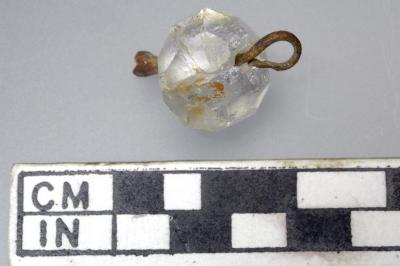
Button Physical Object
Accession Number
1986.008.0108aCategory
Creation Date
circa 1620Description
A round, multi-faceted, crystal bead, slightly flattened in profile, appears to be made of quartz. It is centrally perforated, and the hole is fitted with a bronze wire, doubled and looped at one end, and fitted with a decorative bronze floret at the other to hold the bead and fix the loop in place. Similar crystal beads have been found in the southeastern US and are called “Florida Cut Crystal Beads,” with the belief that they were Spanish items designed to be traded with Native American peoples. These examples from Santa Margarita have no such context and appear to be decorative dress buttons. One of 6: See also 1986.008.0108b--f. Fragment of fitting detached (see 1986.008.0108b). One of 6 crystal buttons. See also 1986.008.0108b--f.Dimensions
1.9 x 1.3 cm. 2.97 grams.
Exhibition Label
Case Caption (2023):A COLONIST— DOÑA MARÍA DE AYALA
Doña María de Ayala had traveled from Spain to Potosí with her husband, Martin Salgado de Rivera, in 1615. High in the Andes, Potosí has cool, wet summers, icy winters, and sits on a barren plain. Everything the couple needed had to be carried up the mountains by llamas. María’s day would have been spent working with her servants to stretch household supplies, haggling with local traders for food and fuel, and mending linens and clothes that could not be readily replaced. Occasionally, floods and earthquakes would add to María’s troubles.
But her husband’s appointments had made them wealthy. When they sailed for Spain, they were accompanied by María’s maid, Catalina, and two very young, possibly Indigenous, servant girls. They all drowned aboard the Nuestra Señora de Atocha.
Object Caption (2023):
Crystal Buttons
Quartz (c.1600)
Gift of Jamestown Inc.
1986.008.0108a-g