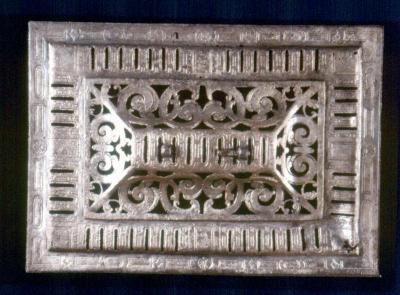
Brazier Lid Physical Object
Accession Number
1986.012.0001Creation Date
circa 1600Materials
Description
Cast silver. Large molded-rectangular form and flat-chased with a conforming outer border of alternating pierced ovals and rectangles interspersed at the centers with stylized fanshells, the raised center pierced and chased with interlacing open scrollwork and surmounted by a handle mount (handle absent). Note: Braziers are heating receptacles for burning charcoal, and in the Seventeenth century they were found principally in the East and Southern Europe. Although a variation of this form is still in use in Spain and Northern Africa, very few braziers of this type have survived their Eighteenth century fall from favor and consequent relative obscurity. The exceptional chasing, cartouche work and sheer silver weight of this example are remarkable. .Dimensions
33.9 x 23.8 cm.
Exhibition Label
Case Caption (2023):A COLONIST— DOÑA MARÍA DE AYALA
Doña María de Ayala had traveled from Spain to Potosí with her husband, Martin Salgado de Rivera, in 1615. High in the Andes, Potosí has cool, wet summers, icy winters, and sits on a barren plain. Everything the couple needed had to be carried up the mountains by llamas. María’s day would have been spent working with her servants to stretch household supplies, haggling with local traders for food and fuel, and mending linens and clothes that could not be readily replaced. Occasionally, floods and earthquakes would add to María’s troubles.
But her husband’s appointments had made them wealthy. When they sailed for Spain, they were accompanied by María’s maid, Catalina, and two very young, possibly Indigenous, servant girls. They all drowned aboard the Nuestra Señora de Atocha.
Object Caption (2023):
Lid of a Brazier
Silver (c.1600)
Gift of James A. Snyder
1986.012.0001
Braziers, bed warmers, and other devices could be filled with hot coals to keep small areas warm. A brazier like this would even fit under a woman’s dress as she sat at a task.