Beaker Physical Object
Accession Number
1987.013.0001Category
Creation Date
circa 1600Materials
Description
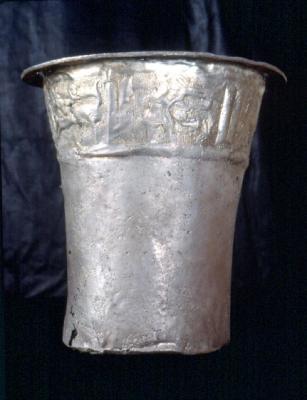
Tapering cylindrical form, wide everted rim, decorated around the sides with a musician, a standing lion, a horse and rider and a mountain climber. Absent three small sections around the sides. 15.2 by 14.0 cm in diameter at rim.Exhibition Label
Case/ Object Caption (2023):Heraldic Plate And Beakers
Silver (Peru, Inca, c.1620)
Gift of Dr. Edwin Davis, Jr., Elliott Dechon, Jr., Mel and Dolores Fisher,
Treasure Salvors Inc., Museum Acquisition Fund
1987.013.0001, 1998.001.0001, 1999.011.0001
This serving plate is possibly the most significant artifact in the museum’s collection. It has been designed to blend Inca and European decorative conventions in a way that has never been seen elsewhere.
It features two condors, the royal birds of the Inca. They hold a mascaypacha, the woven forelock that originally could only be worn by the reigning Inca emperor. Its pattern had heraldic implications, like a European coat of arms. In colonial times, after the emperor was long deposed, his descendants wore a mascaypacha to affirm their right to rule over their people either independently or under a Spanish overlord.
At a feast, friends would have toasted each other using the Inca drinking vessels, known as aquillas. This pair was found on the wreck of Nuestra Señora de Atocha, stored stacked one inside the other in the traditional manner. Images on the better-preserved beaker show the mountain of Potosí, a church, and scenes of caravans of llamas and herders, as well as miners going to work. They were most likely made by one of the three Indigenous silversmiths working in Potosí at that time.