Silver Bar Physical Object
Accession Number
1987.021.0002Category
Materials
Description
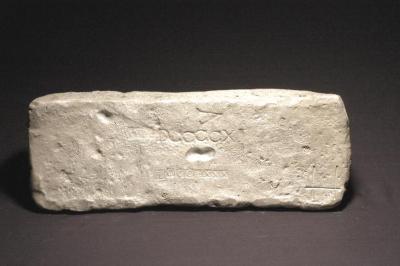
A central “scoop” on the face of the ingot is a characteristic of ingots produced at Potosí. It was made by the assayer when he sampled the silver to determine the ingot’s purity. Another set of smaller Roman numerals read IIUCCCLXXX, showing the silver was 2380 parts pure silver of 2400, affirmed by the adjoining mark of an assayer named Mexia. This silver ingot bears the Roman numeral DCCCCXI (911), meaning it was the 911th silver bar produced at that Andean mining center in its year. The face is marked with five shield-style tax stamps and a large “A.” The A indicates the ingot was part of the crown’s annual one-fifth share of the silver from Potosí. It was one of 133 such “A” bars on Atocha. The purpose of the “H” style mark in one corner of the face is unknown.Dimensions
35.0 x 12.8 x 9.0 cm. 73.87 troy pounds, 27.57 kilograms, 60.79 pounds
Exhibition Label
Object/Case Caption (2023):Ingots
Silver (Peru and Mexico, 1621)
Gifts of George Breed, Richard Bulman, Dr. Edwin and Jane Davis, Wayne Densch, Kim Fisher, Mel and Dolores Fisher, Joseph Hoffman, Jamestown Inc., Norman Johnson, Demostines “Mo” Molinar, John Scott, Jerold B. Shapiro
1986.003.007, 1986.008.0065, 1986.008.1496-98, 1986.008.2290, 1987.004.0001, 1987.011.0001, 1987.021.0001-2, 1997.001.0001, 1997.002.0001-3, 1997.011.0015, 1999.016.0001, 1999.001.0001, 1999.007.0002, 2001.009.0006, 2001.014.0001, 2003.008.0001, 2004.004.0001, 2011.004.0001, 2019.005.0001
The millions of silver ingots successfully shipped to Spain were melted down to make coins or other items. Only those recovered from shipwrecks reveal details of the trade.
The Nuestra Señora de Atocha was carrying 1,038 silver ingots, most weighing about 70 pounds. Each one was assigned a serial number, then marked to show where it was mined and its purity. The largest single owner of the Atocha’s silver was King Philip IV, but nearly two-thirds of the cargo was being shipped by private individuals. To make sure that there were no mistakes during transport, owners marked their ingots with their logos. If they were shipping an ingot to someone else, they added that person’s logo too. Details were carefully recorded by the silver master on each galleon, who made sure that taxes and freight charges were paid on personal treasure.
[image: diagram]
1. Silver master’s stamp
2. Shipper’s logo
3. Purity mark
4. Tax stamp
5. Assayer’s scoop
6. Serial number
7. Receiver’s logo
This ingot was being shipped by A. de Aguirre to H. de Almonte. Their personal logos – a linked “AGE” and an “H3” – are marked on the face of the ingot, as are the circular, shield-style stamps that prove that the 20% tax was paid to the crown on the value of the silver. The large Roman numeral VUII, indicates it was the 5,002nd ingot produced in Potosi that year. The deep scoop in the middle of the ingot was made by the assayer when he sampled the ingot to determine its purity, which is specified by the Roman numerals IIUCCCLXXX, indicating that it was 2,380 parts pure silver out of 2,4000. Two Vs at either end are the marks of Nuestra Señora de Atocha silver master, Jacob de Vreder, showing that he registered the ingot as it came aboard the galleon.